Showing posts with label gravel. Show all posts

Wednesday, February 5, 2014

What Is Flagstone And How Do You Lay It Down?


Flagstone is a general term referring to any sedimentary rock that cleaves naturally into stepping stone shapes. Because of the large size and weight of flagstone, it does not require the extensive base preparation of an interlocking pave patio. In most cases, I can lay the stones directly on stable, well tamped soil, although a two inch bed of screed ed sand will make it easier to place and level stones of varying thickness. If the soil is very soft or unstable which means having severe frost I will need to lay down a two to four inches layer of compatibility gravel sub base material  land compact it with a hand tamper.


Limestone, quartzite, and slate are some of the most common rock types in the flagstone category. If you are going to use flagstones for your patio or walkways, the flagstones should be at least one inch thick, but at 11/2 to 2 inches is better, because flagstones are split and cleaved into more usable and manageable sizes, not cut, their shapes are slightly irregular, which contributes to their natural quality.
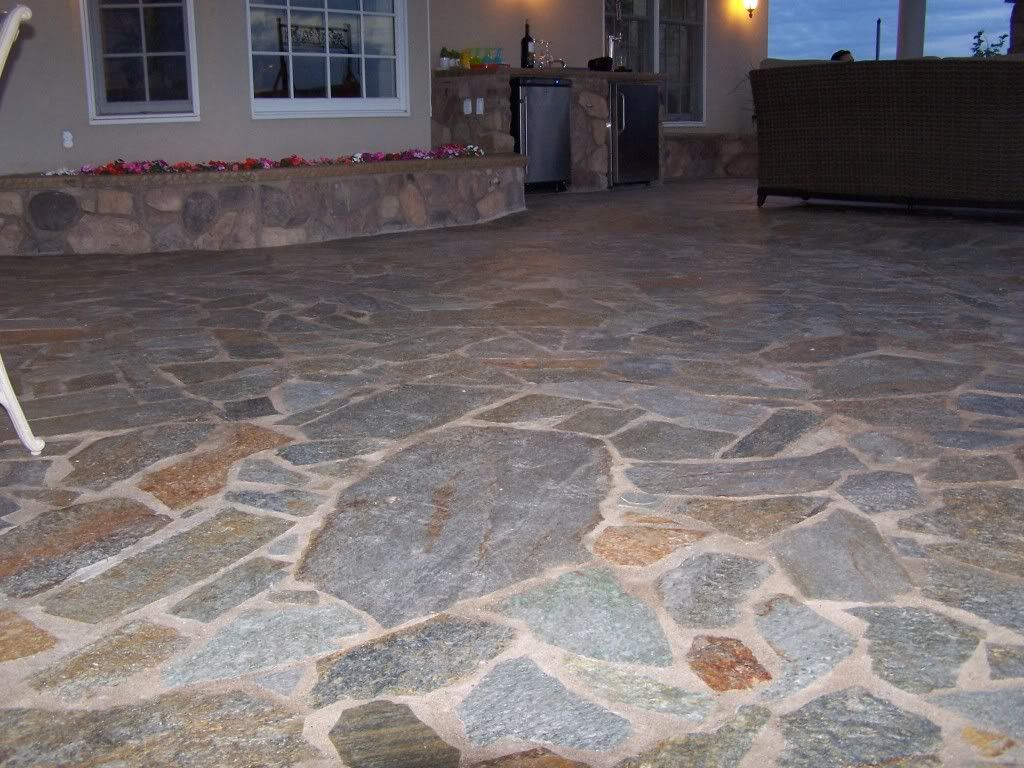


When you are laying out your stones for a patio or walkway, it is like putting a jigsaw puzzle together. As you are laying your stones you want to lay the stones in an eye-pleasing pattern, and you will want to fit them together good so you want have to cut some many stones. Most of the time, the thickest stones are  laid around the perimeter, which serves, as a border to help keep the thinner stones in place. Sometimes the largest stones are placed near the center of the patio and you can do this if you want to. When you are picking out your stones to use, it is best to use large and small stones and placed them in a random pattern, with staggered joints. Most of the time, the larger stones are laid and leveled first, then the smaller stones are fitted in between the larges ones. This way you can be limit to any cutting to the smaller stones.


Before you start laying your base materials, you can experiment with different patterns to make best use of the stones. When you are doing this you start at one corner or side, to figured out your pattern that you want for your patio or walkways.You do not need to dry-lay the entire walkway or patio, but you should at least play around with the stones to get a feel for how they will fit together. But if you do decide to dry-lay the entire project whether it is a patio or walkway, you will need to keep the dry-lay intact, transplanting the stones one at a time into the work site. Another way you can take a picture of the dry-lay and then you can  use it as a reference for redoing the project in your work site. Also you need to keep the joints between the stones from 1/2 inch to not more than 11/2 inch wide.

Since flagstones weighs so much it is a good thing to get plenty of help handling them.

Summary

When you are thinking about using flagstones to make a patio or walkways it is best to make a plan before you do the real thing.



How To Repair Gravel Paths And Edges ?


I have gravel path in my driveway, it is good because if my car is dripping oil, the gravel will soak up the oil. However if I have a gravel path, it will have grass growing in between the gravel with grass and the grass can be trodden into the house. 


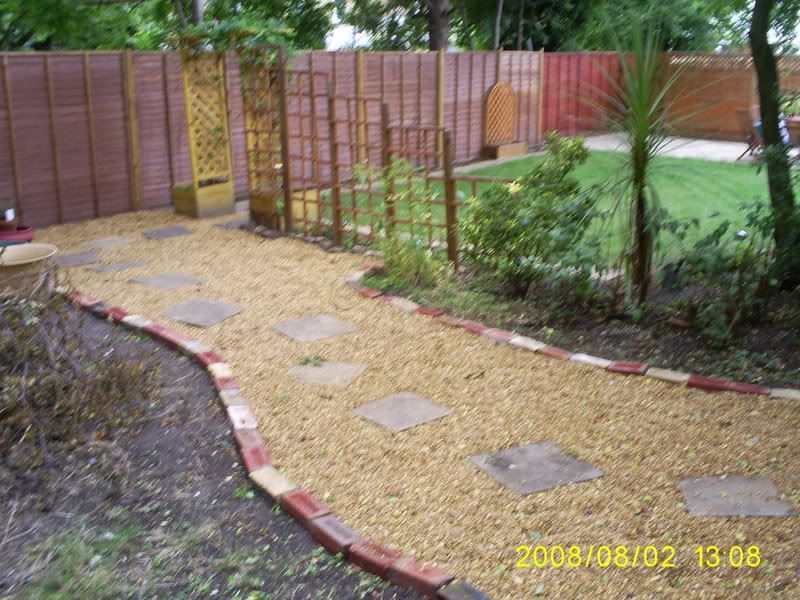
To maintain a gravel path, I will need to rake the path very often and I will need to put the application of weedkiller down very often to keep my gravel path looking real good. I can buy silicone resins and  applied it to the gravel to help bind the stones together without affecting their appearance. Thin area can simply be filled by pouring on a bag of new gravel and spread it out with a garden rake.

When I am spreading the gravel out where it is suppose to be I will need to add concrete edges  strips. There should be set on a bed of mortar and hold upright while the mortar sets. If I do not like to use concrete edging strips, I can use bricks or wood instead.

I do not have a garage and I have to park my car out on the gravel path, I can use the oil catching properties there. The concrete will act to keep the gravel in place and the gravel will catch any oil drips. I will need to dig out the area, add compacted hardcore, then add sand and coarse gravel, with fine gravel to level to lay a new gravel path.

Edging is an important part of paving, because it can help to hold the main body of paving in place. There  are many different kinds of edging with concrete edging being the one that is used the most with concrete. Concrete blocks can be used as a edging with a gravel path or drive.

All masonry edging should be bedded in mortar, no matter which kind of paving that has been laid.

When my edging has become loose, take it out and remove all of the old mortar. Put a layer of fresh mortar and push the edging back into place, by using a straightedge to align them with their neighbors, I will need to drive some timber pegs in to hold the edging vertical and tight against the paving finish off by applying a 45 degree fillet of mortar along the base of the edging between the pegs. Now lay a bed of fresh mortar and push the edging pieces back into place, and put them in line with the others. Put in the timber pegs to hold the edging vertical and tight against the paving I will need to finish it off by applying a 45 degree fillet of mortar along the base of the edging between the pegs.

After the mortar has sit, I will need to take the pegs  out, and fill the peg holes with mortar and hide it with soil or grass.

Summary

In this article, we are talking about gravel paths and edges. To me, this goes with how my property looks.

Paths really make a smart look and if I have a very neat or interesting edging, this would make it to look nice.